In the middle of a rather searing summer last year, I happened to catch UP 7435 East, a double-stack train, passing the stopped UP 7405, just past Gold Run:
I shot this with my older Flip Slide in HD but this particular cam, as you can see, lacks any form of image stabilization. That heat + my age = fairly unsteady. Also note that you can hear UP radio traffic. Listen closely. As always, if you open the video in YouTube, expand it and listen with headphones, the experience is enhanced.
The situation is this: UP 7405 (a GE C45ACCTE, 4,400 hp, built in 2009, known by GE as their ES44AC), a westbound (downhill) grain train, hit the detector at MP 154.4, which activated. The engineer stopped his train prior to the Gold Run crossing.
I was examining the EOT device when I heard UP 7435 coming uphill. UP 7435 is likewise a 2009 ES44AC with 4,400 hp. Directly behind was UP 5651, a GE C44ACCTE built in 2004 and rated at 4,390 hp. Pushing in DPU status at the end was UP 7637, a C45ACCTE built in 2007, rated at 4,400 hp.
Go ahead, hit me. I can hear the comments coming already.
MP154
P.S.
I still haven't found the time to upload the newer cab shots. Even with DSL, the number of photos I want to post will consume the better part of an entire day to upload. And I have two posts of equally gigantic size to make. In lieu of that, I'll be making a quick-grab post about another excursion in an older UP locomotive shortly.
Monday, January 23, 2012


Sunday, January 15, 2012
UP 5770 At Carpenter Road

I was recently -- just in January -- invited into the cab of two new UP units representing the best of the two major American locomotive builders: GE and EMD.
I first visited a GE ES44AC unit, which features 4,390 hp. I next visited an EMD SD70ACe unit, which features 4,300 hp.
Whilst I line up those photographs (I took over 60 in each cab) and one video, I'd like to share the video below with you, of a mixed manifest train featuring five units; four in front and one DPU:
In detail, UP 5770 on point is a GE ES44AC (called a C44ACCTE by Union Pacific) manufactured in 2002, with 4,390 hp.
Next up is UP 6520, a GE C44AC manufactured in 2000, with 4,390 hp.
Third in line is UP 8222, a rather rare SD90MAC which UP labels as an SD9043AC with 4,300 hp and built in 1998.
Fourth place features UP 2327, another rare EMD unit, which is an SD60M with 3,800 hp, built between 1988 and 1992.
At the rear in DPU (Distributed Power Unit or "dupe") status is UP 5564, a GE C44ACCTE with 4,390 hp, manufactured in 2004.
As you can see here in a view provided by Google Maps, the train is traveling eastbound (uphill) from Colfax and over the Long Ravine bridge.

Here, the grade begins to get steeper, though the Ruling Grade over Donner is 2.4%.
NEXT UP:
Actual photos from the two new GE and EMD cabs. Simply uploading these photographs will take, for me, literally hours over my DSL connection. First will be the GE ES44AC cab, then the EMD SD70ACe cab.
Take care, be safe.
MP154
Wednesday, January 4, 2012
Get On Board: Another Cab Visit

I am conflicted, as you might surmise, when I board a cab interior whilst -- in direct contravention of various rules and regulations -- I am therein invited in.
I suspect it is because I am a representative of an elder generation and because -- logically so -- I present no clear threat to UP staff and personnel.
Because, in fact, I truly present no threat.
Any UP employee who invites any individual into the cab also invites their own dismissal, their own firing, and perchance their own prosecution under any number of TSA or Homeland Security edicts.
Despite this, I find myself invited into any number of locomotive cabs because, after all, I only wish to document the newer, upgrade cabs in real time.
More photographs coming.
From a modern cab unit.
MP154
Tuesday, December 13, 2011
Shed 10
 Above, you can see the relationship of Shed 10 (concrete edifice on bottom) to Interstate 80 at the top. Click on image to enlarge. Linking the concrete snow shed on the left (west) is the trestle illustrated in photographs below.
Shed 10 connects one of two points on Union Pacific's east/west Roseville Subdivision where rail traffic is constricted, from a double track to a single track.

The line is currently single-tracked between these points:
1. Between Switch 9 (MP 171.2) to Shed 10 (MP 178.2), a total of 7.1 miles;
2. Between West Norden (MP 191.2) to Shed 47 (MP 196.6), a total of 5.4 miles;
Trains clog up going eastbound at the mouth of Switch 9 and Tunnel 41; trains clog up going westbound just prior to Shed 47 and prior to Shed 10 (historical article about the snowsheds here).
Shed 10 rests on the eastern end of one of these single tracks, with Switch 9 on the western end of the single track, over Donner Pass. This 7.1 mile section is a bottleneck that constricts traffic -- particularly now that UP can run double-stack traffic over Donner -- as illustrated here since 2009.
Track 1 and Track 2 over Donner Pass used to be continuously double-tracked, until Philip Anschutz purchased Southern Pacific in 1988 and ripped up portions of track in 1993 in order to distribute that rail to other lines (the Sunset Route, for one) without having to purchase new rail. That is when those two single-tracked choke points were created -- by the prior owner's short-sightedness and false thrift.
The current owner, Union Pacific, is considering double trackage again, along the entire route. Union Pacific may, in fact, be quite serious about laying back down a second track again, as it spent millions of dollars to open up its tunnels along Donner Pass so that double-stack container cars could be accommodated in November of 2010.
 View of I-80 which is located just north of Shed 10. This shot is looking east towards the higher elevations.
 UP 4184, an SD70M built in 2001, 4,000 hp, rolls westbound (downhill) on the single track that begins behind the locomotive in Shed 10. You can see the vertical red signals through the trees, just over Shed 10's western portal.
 UP 5723 exits the western portal of Shed 10 over the trestle built in 1904 by Southern Pacific. This is a GE C44ACCTE. You can also see, on this shot, where there is clearance for a second track and, as such, where the second track obviously used to be.
 The very last of its kind over Donner, CNW (Chicago NorthWestern) unit # 9776 (a GE C44-9W) exits the western end of Shed 10 as its train rolls downhill under maximum track speed of 25 mph.
 In a broader view, the DPU for UP 7614 (another GE C44ACCTE) rolls over the western trestle of Shed 10 in dynamic braking. Here, you can see the access maintenance road for Shed 10 itself.
 The trestle's construction date is clearly marked underneath on one of its diagonal metal braces, round rivets plainly evident. In 2011, this span is 107 years old and still holding its own despite over a century of Sierra Nevada winters and the abuse of heavier and heavier trains.
 The western end of Shed 10, ballast over the trestle, and CWR (continuous welded rail) held over the single track by newer clips and not spikes, with heavy metal ties underneath. Again, you can see there is clearance for another track on the left, should UP decide to add an additional line.
 BNSF 4654, another C44-9W, rockets up Donner in resplendent new War Pumpkin paint on approach to Shed 10, with gorgeous silver trucks and fuel tanks. BNSF still has trackage rights over Donner when necessary, in order to satisfy various past FRA merger deals.
  A view of the western trestle approach to Shed 10. In the spring, this draw is awash with the cascading snow-melt of the previous season.
 Here, you can see the distance between Shed 10 to the east, and Switch 9 to the west. Interstate 80 parallels the rail lines because the hard work was already accomplished. The route of I-80 did nothing more than easily mimic the shatteringly-difficult work of the original Transcontinental Route over the Sierra Nevada mountains.
Shed 10 is one of the few active snowsheds still left over Donner, built with concrete and protecting a valuable transition point on the line. With the final removal of the original massive wooden timbers shrouding the western portal to The Big Hole (Tunnel 41), Shed 10 stands as a stark reminder that winter snows once easily occluded the rails over Donner Pass, and where Norden, in winter, was essentially a small town, buried under 40+ feet of snow.
Shed 10 still stands today in contrast to the bulk and the rest of its uncovered and unfettered trackage.
MP154
Friday, November 11, 2011
Inside The Cab, Part II

As I wrote in my January 2011 post "Inside The Cab, Part I," I have to admit that, from my very early interest in trains, my goal was to find out what happens in the cab of a locomotive on point.
And since my concentrated interest in 1996, it didn't take me long before I was invited inside.
Luckily, my interest coincided with the transition of the purchase of Southern Pacific by the Union Pacific. All the engineers, at that time, had great loyalty to the "friendly SP" as opposed to UP. And trust me -- SP was infinitely more friendly than UP. Former SP or retired SP employees will unanimously agree.
My first invitation into a cab came when a train was halted in Gold Run and shoved into the eastern siding, waiting for Dispatcher 74 to clear them. Snow was all around. The lead unit was a battered UP SD-60. And I do mean battered.
I went home and snatched a plate full of just-out-of-the-oven chocolate chip cookies. Getting out of my car and trudging through about three feet of snow, I yelled up at the cab. The window slided open and I was invited into the cab -- for clear reasons.
I met an engineer whom I encountered many times on the road and has invited me into the cab for various rides since -- to the point where I was given the opportunity to operate the controls on a couple of very clandestine runs. Those were, frankly, the times of my doddering life, a few years ago. I think my age also helped: I'm not a kid (far from it) and I am customarily festooned with cameras.
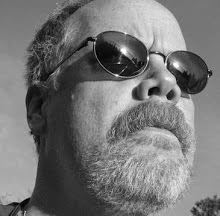
Because of my fascination and interest in the locomotive cab and what happens there, I'm on the lookout for interesting videos and photographs. I'll be posting a few photographs of myself in the cabs of locomotives [such as the one of me above, in Burlington Northern #8039, an EMD SD40-2 built in August of 1979 with 3,000-hp, stopped near Switch 9], and other interior shots -- of SD70Ms, SD60Ms, SD40T2s, SD90MACs, C44-9Ws and more. I'm currently on vacation in Ft. Bragg, California as I write this -- and don't have my terabyte external drive with me -- or I could post some of my cab photographs now.
In the meantime, please enjoy some YouTube videos of what it's like "inside the cab."
Engineer Jim works for Metra passenger rail:
What's it like inside an SD60M?
Here is a Canadian National recruitment video for conductors. Embedding has been disabled on YouTube by CN's request. It's interesting to note the inclusion of the controversial Belt-Pak, which has eliminated a number of jobs for yard engineers.
Here's how to make your SD40 travel faster:
Not everything works perfectly in the cab:
Here, it's time to drive an EMD F7 unit:
Nice (and very rare) cab ride in an Amtrak GE P42DC unit, with subject of the video sitting in the co-engineer's seat (not the primary engineer's seat). Because there are actual conductors aboard a passenger train, there are two qualified engineers in an Amtrak cab. The person sitting in what would customarily be the conductor's seat in a freight cab is called the co-engineer.
More to come!
MP154
I went home and snatched a plate full of just-out-of-the-oven chocolate chip cookies. Getting out of my car and trudging through about three feet of snow, I yelled up at the cab. The window slided open and I was invited into the cab -- for clear reasons.
I met an engineer whom I encountered many times on the road and has invited me into the cab for various rides since -- to the point where I was given the opportunity to operate the controls on a couple of very clandestine runs. Those were, frankly, the times of my doddering life, a few years ago. I think my age also helped: I'm not a kid (far from it) and I am customarily festooned with cameras.
Because of my fascination and interest in the locomotive cab and what happens there, I'm on the lookout for interesting videos and photographs. I'll be posting a few photographs of myself in the cabs of locomotives [such as the one of me above, in Burlington Northern #8039, an EMD SD40-2 built in August of 1979 with 3,000-hp, stopped near Switch 9], and other interior shots -- of SD70Ms, SD60Ms, SD40T2s, SD90MACs, C44-9Ws and more. I'm currently on vacation in Ft. Bragg, California as I write this -- and don't have my terabyte external drive with me -- or I could post some of my cab photographs now.
In the meantime, please enjoy some YouTube videos of what it's like "inside the cab."
Engineer Jim works for Metra passenger rail:
What's it like inside an SD60M?
Here is a Canadian National recruitment video for conductors. Embedding has been disabled on YouTube by CN's request. It's interesting to note the inclusion of the controversial Belt-Pak, which has eliminated a number of jobs for yard engineers.
Here's how to make your SD40 travel faster:
Not everything works perfectly in the cab:
Here, it's time to drive an EMD F7 unit:
Nice (and very rare) cab ride in an Amtrak GE P42DC unit, with subject of the video sitting in the co-engineer's seat (not the primary engineer's seat). Because there are actual conductors aboard a passenger train, there are two qualified engineers in an Amtrak cab. The person sitting in what would customarily be the conductor's seat in a freight cab is called the co-engineer.
More to come!
MP154
Friday, October 28, 2011
The Tale of UP 7783 East: A TRIPLE Train Meet
UP 7783 East passes by MP151 towards Gold Run, flanges squealing, not making track speed.
 Nearing the Casa Loma crossing, UP 7783 is just about to stall.
 CN 2614 is a very rare unit. Canadian locomotives or cars are very seldom seen over Donner Pass.
 The locomotives were sanding like mad but still losing speed.
 The General Electric mid-train DPU, UP 5270.
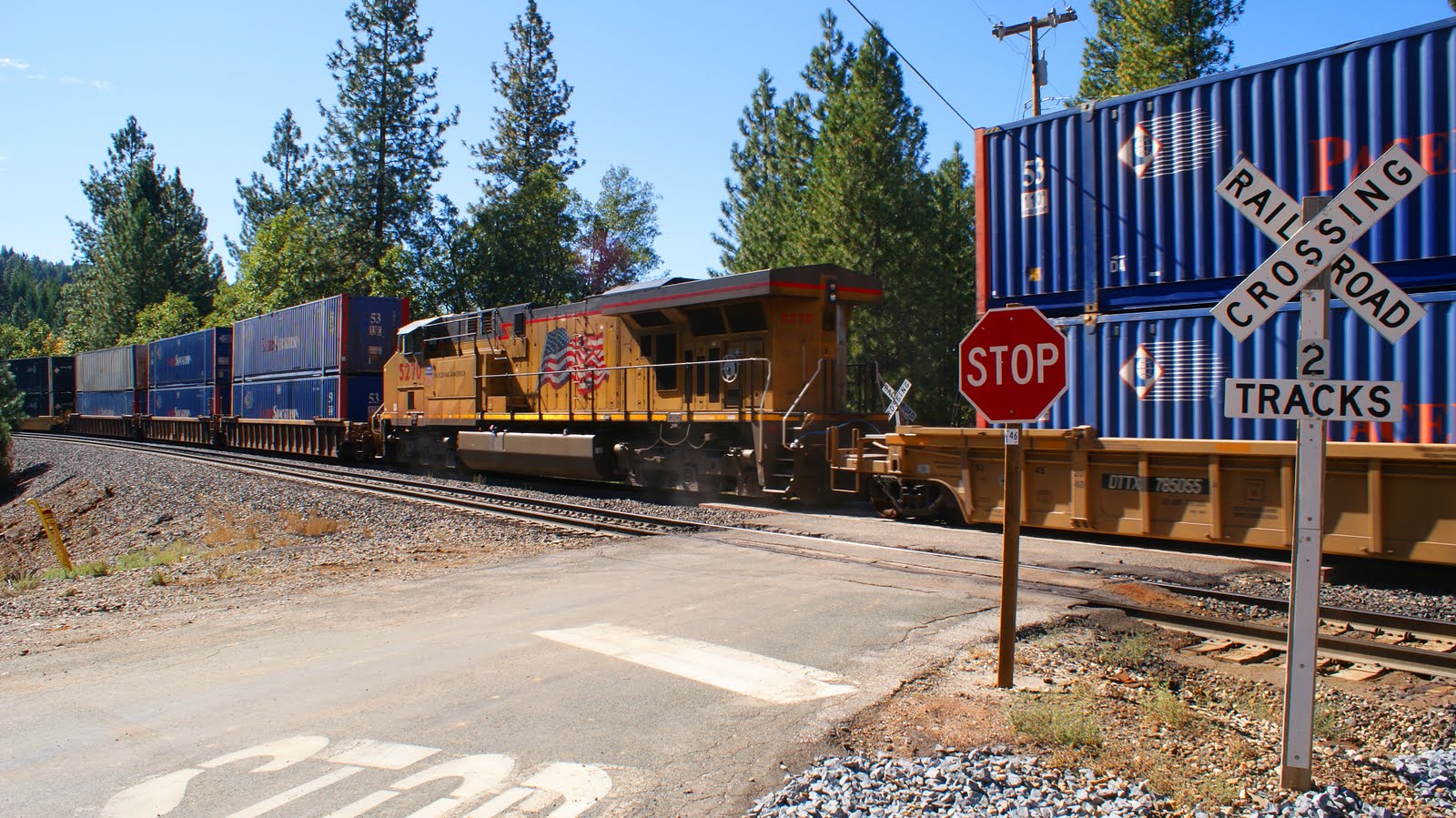 Crossing Casa Loma, moving very slowly.
 Stalled. UP 4073 was the culprit.
 Amtrak's California Zephyr #6 crept up behind UP 7783 East and stopped a few hundred yards behind.
 As Amtrak engineers puzzled over the back wall settings of UP 4073, an intermodal train passes on the #1 track downhill, producing brake smoke. Maximum speed for freight here is 25 mph.
 Multi-burst and bracketing. Perfectly framed between intermodal containers.
 An actual "triple train meet." The rear of UP 7783 East, Amtrak #6, and the DPU (UP #5277, a GE C45ACCTE) of the downhill (#1 track) intermodal train.
 Now loading, UP 4073 finally starts to pay its way and push.
 Great exhaust all around. I'm one of those oddballs who enjoys the smell of diesel in the morning.
 Conductors conferring, then back to their train.
 Conductors back to the cars, engineer back to his GE P42DC lead unit.
 Amtrak locomotives, like their cars, are dinged up. The cover for the right-side sand fill is missing completely.
 Amtrak #6, on its way.
As per normal, I was out and about (nicely equipped with cameras and video, as well as handguns) when I happened to spot a unique train moving uphill on the eastbound #2 track, out of Colfax (California). A beautiful black and red unit was in second position on this intermodal train -- a Canadian National locomotive. This is an exceedingly rare sight on the Roseville Subdivision over Donner Pass and I wanted to capture its passage.
I left Colfax on I-80 and set up my video tripod as well as my Sony cameras near milepost 152. I waited longer than normal because I didn't realize, at the time, that the train was having DPU (Distributed Power Unit or "Dupe") problems.
Using my Flip HD camera, the above video records UP 7783 on point, a 4,400-hp General Electric C45ACCTE built in 2007, with CN 2614, a 4,400-hp GE C44-9W built in 2000 directly behind, pulling a long intermodal train.
Mid-train, helper unit UP 5270, a 4,400-hp GE C45ACCTE built in 2006 powers by, with two final DPUs on the rear: UP 4073, a 4,000-hp EMD SD-70M built in 2000, and UP 5359, a 4,400-hp GE C45ACCTE built in 2005.
[Note: units that Union Pacific designates the C45ACCTE are actually termed the ES44AC by the builder, General Electric, as in: Evolution Series, 4400-hp, AC traction motors.]
Five engines for an eastbound intermodal train?
However, clearly all five engines were needed because when the train passed the Dutch Flat detector at milepost 154.4, it was moving at a measly 12 mph, less than half the authorized track speed at that point for freight traffic -- 25 mph. Passenger traffic is authorized here for 30 mph.
Finally, after I had driven ahead of the train to Casa Loma Road, above Towle, UP 7783 stalled just past that crossing as I watched. I had parked on the wrong side of the tracks, if I wanted to get back home. The train now blocked my way.
Here's where it gets interesting:
UP 7783 called Amtrak #6 behind it (Amtrak already having queried Dispatcher 74 about passing the slower train in front of it, against traffic, on the number one track and was refused.) and asked if its engineers could check the rear DPUs -- specifically UP 4073 (the eldest unit in the bunch) -- to see if they were even running.
I watched as Amtrak #6 pulled up slowly behind the rear Union Pacific locomotives. An Amtrak engineer and two conductors walked towards the potentially-problematic unit. Through radio traffic, relayed by hand-held portable radios because the cab radio in UP 4073 wasn't working, the engineer on UP 7783 asked the position of the isolation switch on the back wall.
It turns out the isolation switch was turned to START-STOP-ISOLATE and not into RUN. With one flip, the EMD unit began to load.
[As an aside: what does "load" mean? LOAD means that the power produced by the diesel engine in the locomotive is transferred to the generator, which in turn creates electricity feeding the traction motors.]
All exited the EMD cab and walked back to their Amtrak train.
Problem solved.
In the meantime, I happened to catch a TRIPLE train meet when a westbound (downhill) UP intermodal train passed by on the number one track.
Documenting a train meet on video or photographically? Rare. Documenting a TRIPLE train meet? Priceless.
MP154
P.S.
As per normal, click on each photograph to enlarge.
Saturday, August 27, 2011
High Speed Rail, Now? Remarkably STUPID In Nature:

So-called "high speed rail" is a non-starter in this nation.
As it SHOULD be.
We cannot afford it.
Not now.
Not in the foreseeable future.
As I wrote here:
High speed rail is a non-starter in a crap economy. I'm a massive railfan and even I know this. Fornicalia has its own high-speed multi-billion-dollar HSR boondoggle that an addled and drugged electorate voted for three years ago. Has even one mile of track been laid under this bond? Why, gosh, that would be a resounding NO. And broadband? It's the government's responsibility to provide broadband for me high in the Sierra Nevada mountains? WTF? What planet are you from?
California's Proposition 1A managed to pass in November of 2008, which committed Fornicalia to BILLIONS of dollars due to a naive electorate:
FORNICALIA PROPOSTIONS:Despite logic, 1A passed. Because it just somehow felt good. Besides, it wasn't dollars from the electorate, was it? Dollars from voters? Dollars from me? Dollars from you? Of course not. Only dollars from -- somewhere. Nine BILLION dollars.Prop 1A - High Speed Rail BondNO. Rail creation of any kind, particularly "high speed" rail, is expensive beyond measure. In 1908 it cost $0.75 per track foot, or $3,960 a mile. Recently, 6.3 miles of American "light rail" extension at 2007 prices costed out at about $2 billion dollars. The Union Pacific recently estimated per-mile costs of new freight at a minimum of $385 million per mile. Currently Union Pacific rail renovation projects for heavy freight over Donner Pass (the area where I live) include the replacement of 136-pound rail with 141-pound rail. That is to say, one yard of each rail equals either 136 or 141 pounds. Freight rail doesn't have to be incredibly precise; it just has to be durable and heavy. High speed rail must be precise, accurately-gauged, cambered in curves and inaccessible. It isn't just a matter of laying rail; it's a matter of purchasing brand new right-of-way for the track proper and sufficient extra right-of-way to ensure safety and inaccessability for those bent on damaging or derailing HSR. Finally, I want no further link from Southern Fornicalia to Northern Fornicalia. The Surenos can keep their gang bullshit right where it is, thank you.
However, would you somehow be shocked that the tariff for this project managed to creep up from $9 billion dollars to $43 billion dollars -- and that is a low estimate? Some say that $100 billion is the proper starting point.
From the San Mateo Daily Journal:
The High-Speed Rail Authority has bungled the project from the beginning with poor management, a lack of a coherent business plan, no realistic estimates of cost, ridership or fares, no final decision on the route and even less chance of obtaining the tens of billions of dollars in private financing that is needed to complete the system.It is difficult to fathom how Brown cannot see that a high-speed rail system in California is doomed to failure. The estimated $43 billion for the first phase of the project from the Bay Area to Anaheim is likely to be way low.
The $9 billion in bond authority approved by the voters in 2008 won’t even cover a quarter of the cost, and requires matching funds that are not likely to be forthcoming.
Despite all of these problems, the rail authority is moving ahead with plans to lay 100 miles of track in the Central Valley. Even though this is the least expensive and least complicated part of the route, cost estimates already are running way higher than forecast.
Initial reports on the segment that would almost but not quite connect Merced and Bakersfield were estimated to cost $7.1 billion just for the track. Those cost estimates are now as much as $13.9 billion, and this is the easy part of the project.
It would not be surprising if the cost of the complete rail project rose north of $100 billion. No wonder the Legislative Analyst’s Office advised against Brown’s request for $185 million to keep the project alive.
Even with large subsidies, ridership is not apt to be anywhere near what is needed to keep fares competitive with airlines, even with higher fuel prices.
Shocked, are you? Shocked and astounded?
Myself, not so much.
Further, what of Mr Obama's so-called HSR "vision"?
In a nutshell: Obama's "vision" of HSR is neither green nor efficient nor practical.
HSR works reasonably in the Northeast Corridor with Amtrak's Acela and other trains.
In the meantime, Mr Obama "commits" $13 billion towards national HSR. With the above figures discussed, this is an infinitesimal drop in the bucket.
Americans: you are being FLEECED.
So that perhaps a few -- at highest estimate -- thousand riders can benefit from low fares and convenient stops?
Again: insanity.
This is NOT the time nor the PLAN.
MP154
Subscribe to:
Posts (Atom)


 Posts
Posts

