Friday, October 28, 2011

The Tale of UP 7783 East: A TRIPLE Train Meet


UP 7783 East passes by MP151 towards Gold Run, flanges squealing, not making track speed.

Nearing the Casa Loma crossing, UP 7783 is just about to stall.

CN 2614 is a very rare unit. Canadian locomotives or cars are very seldom seen over Donner Pass.

The locomotives were sanding like mad but still losing speed.

The General Electric mid-train DPU, UP 5270.
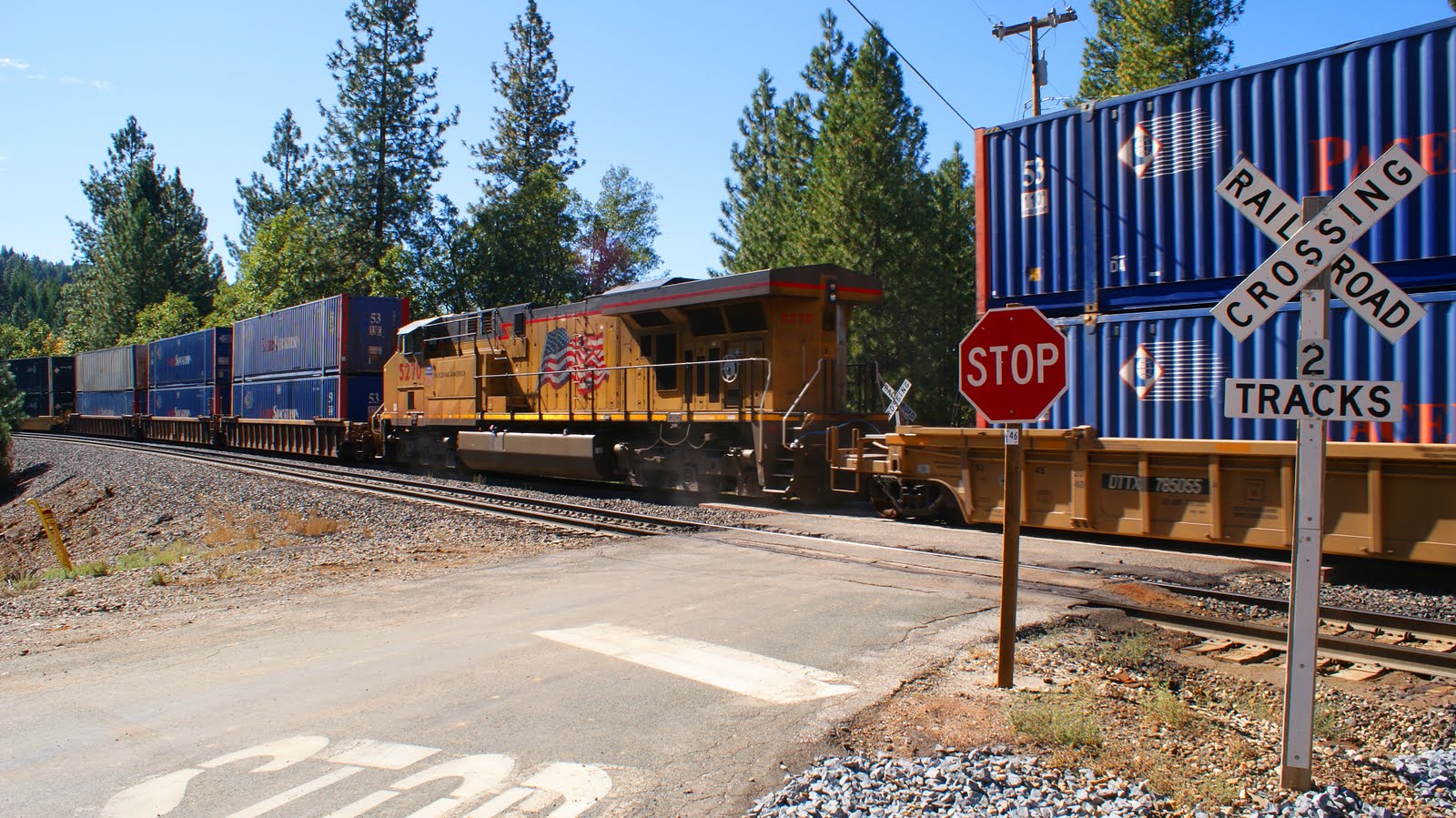
Crossing Casa Loma, moving very slowly.

Stalled. UP 4073 was the culprit.

Amtrak's California Zephyr #6 crept up behind UP 7783 East and stopped a few hundred yards behind.

As Amtrak engineers puzzled over the back wall settings of UP 4073, an intermodal train passes on the #1 track downhill, producing brake smoke. Maximum speed for freight here is 25 mph.

Multi-burst and bracketing. Perfectly framed between intermodal containers.

An actual "triple train meet." The rear of UP 7783 East, Amtrak #6, and the DPU (UP #5277, a GE C45ACCTE) of the downhill (#1 track) intermodal train.

Now loading, UP 4073 finally starts to pay its way and push.

Great exhaust all around. I'm one of those oddballs who enjoys the smell of diesel in the morning.

Conductors conferring, then back to their train.

Conductors back to the cars, engineer back to his GE P42DC lead unit.

Amtrak locomotives, like their cars, are dinged up. The cover for the right-side sand fill is missing completely.

Amtrak #6, on its way.

As per normal, I was out and about (nicely equipped with cameras and video, as well as handguns) when I happened to spot a unique train moving uphill on the eastbound #2 track, out of Colfax (California). A beautiful black and red unit was in second position on this intermodal train -- a Canadian National locomotive. This is an exceedingly rare sight on the Roseville Subdivision over Donner Pass and I wanted to capture its passage.

I left Colfax on I-80 and set up my video tripod as well as my Sony cameras near milepost 152. I waited longer than normal because I didn't realize, at the time, that the train was having DPU (Distributed Power Unit or "Dupe") problems.

Using my Flip HD camera, the above video records UP 7783 on point, a 4,400-hp General Electric C45ACCTE built in 2007, with CN 2614, a 4,400-hp GE C44-9W built in 2000 directly behind, pulling a long intermodal train.

Mid-train, helper unit UP 5270, a 4,400-hp GE C45ACCTE built in 2006 powers by, with two final DPUs on the rear: UP 4073, a 4,000-hp EMD SD-70M built in 2000, and UP 5359, a 4,400-hp GE C45ACCTE built in 2005.

[Note: units that Union Pacific designates the C45ACCTE are actually termed the ES44AC by the builder, General Electric, as in: Evolution Series, 4400-hp, AC traction motors.]

Five engines for an eastbound intermodal train?

However, clearly all five engines were needed because when the train passed the Dutch Flat detector at milepost 154.4, it was moving at a measly 12 mph, less than half the authorized track speed at that point for freight traffic -- 25 mph. Passenger traffic is authorized here for 30 mph.

Finally, after I had driven ahead of the train to Casa Loma Road, above Towle, UP 7783 stalled just past that crossing as I watched. I had parked on the wrong side of the tracks, if I wanted to get back home. The train now blocked my way.

Here's where it gets interesting:

UP 7783 called Amtrak #6 behind it (Amtrak already having queried Dispatcher 74 about passing the slower train in front of it, against traffic, on the number one track and was refused.) and asked if its engineers could check the rear DPUs -- specifically UP 4073 (the eldest unit in the bunch) -- to see if they were even running.

I watched as Amtrak #6 pulled up slowly behind the rear Union Pacific locomotives. An Amtrak engineer and two conductors walked towards the potentially-problematic unit. Through radio traffic, relayed by hand-held portable radios because the cab radio in UP 4073 wasn't working, the engineer on UP 7783 asked the position of the isolation switch on the back wall.

It turns out the isolation switch was turned to START-STOP-ISOLATE and not into RUN. With one flip, the EMD unit began to load.

[As an aside: what does "load" mean? LOAD means that the power produced by the diesel engine in the locomotive is transferred to the generator, which in turn creates electricity feeding the traction motors.]

All exited the EMD cab and walked back to their Amtrak train.

Problem solved.

In the meantime, I happened to catch a TRIPLE train meet when a westbound (downhill) UP intermodal train passed by on the number one track.

Documenting a train meet on video or photographically? Rare. Documenting a TRIPLE train meet? Priceless.

MP154

P.S.
As per normal, click on each photograph to enlarge.

Saturday, August 27, 2011

High Speed Rail, Now? Remarkably STUPID In Nature:


So-called "high speed rail" is a non-starter in this nation.

As it SHOULD be.

We cannot afford it.

Not now.

Not in the foreseeable future.

As I wrote here:
High speed rail is a non-starter in a crap economy. I'm a massive railfan and even I know this. Fornicalia has its own high-speed multi-billion-dollar HSR boondoggle that an addled and drugged electorate voted for three years ago. Has even one mile of track been laid under this bond? Why, gosh, that would be a resounding NO. And broadband? It's the government's responsibility to provide broadband for me high in the Sierra Nevada mountains? WTF? What planet are you from?

California's Proposition 1A managed to pass in November of 2008, which committed Fornicalia to BILLIONS of dollars due to a naive electorate:
FORNICALIA PROPOSTIONS:
Prop 1A - High Speed Rail Bond
NO. Rail creation of any kind, particularly "high speed" rail, is expensive beyond measure. In 1908 it cost $0.75 per track foot, or $3,960 a mile. Recently, 6.3 miles of American "light rail" extension at 2007 prices costed out at about $2 billion dollars. The Union Pacific recently estimated per-mile costs of new freight at a minimum of $385 million per mile. Currently Union Pacific rail renovation projects for heavy freight over Donner Pass (the area where I live) include the replacement of 136-pound rail with 141-pound rail. That is to say, one yard of each rail equals either 136 or 141 pounds. Freight rail doesn't have to be incredibly precise; it just has to be durable and heavy. High speed rail must be precise, accurately-gauged, cambered in curves and inaccessible. It isn't just a matter of laying rail; it's a matter of purchasing brand new right-of-way for the track proper and sufficient extra right-of-way to ensure safety and inaccessability for those bent on damaging or derailing HSR. Finally, I want no further link from Southern Fornicalia to Northern Fornicalia. The Surenos can keep their gang bullshit right where it is, thank you.
Despite logic, 1A passed. Because it just somehow felt good. Besides, it wasn't dollars from the electorate, was it? Dollars from voters? Dollars from me? Dollars from you? Of course not. Only dollars from -- somewhere. Nine BILLION dollars.

However, would you somehow be shocked that the tariff for this project managed to creep up from $9 billion dollars to $43 billion dollars -- and that is a low estimate? Some say that $100 billion is the proper starting point.

From the San Mateo Daily Journal:
The High-Speed Rail Authority has bungled the project from the beginning with poor management, a lack of a coherent business plan, no realistic estimates of cost, ridership or fares, no final decision on the route and even less chance of obtaining the tens of billions of dollars in private financing that is needed to complete the system.

It is difficult to fathom how Brown cannot see that a high-speed rail system in California is doomed to failure. The estimated $43 billion for the first phase of the project from the Bay Area to Anaheim is likely to be way low.

The $9 billion in bond authority approved by the voters in 2008 won’t even cover a quarter of the cost, and requires matching funds that are not likely to be forthcoming.

Despite all of these problems, the rail authority is moving ahead with plans to lay 100 miles of track in the Central Valley. Even though this is the least expensive and least complicated part of the route, cost estimates already are running way higher than forecast.

Initial reports on the segment that would almost but not quite connect Merced and Bakersfield were estimated to cost $7.1 billion just for the track. Those cost estimates are now as much as $13.9 billion, and this is the easy part of the project.

It would not be surprising if the cost of the complete rail project rose north of $100 billion. No wonder the Legislative Analyst’s Office advised against Brown’s request for $185 million to keep the project alive.

Even with large subsidies, ridership is not apt to be anywhere near what is needed to keep fares competitive with airlines, even with higher fuel prices.

Shocked, are you? Shocked and astounded?

Myself, not so much.

Further, what of Mr Obama's so-called HSR "vision"?

In a nutshell: Obama's "vision" of HSR is neither green nor efficient nor practical.

HSR works reasonably in the Northeast Corridor with Amtrak's Acela and other trains.

In the meantime, Mr Obama "commits" $13 billion towards national HSR. With the above figures discussed, this is an infinitesimal drop in the bucket.

Americans: you are being FLEECED.

So that perhaps a few -- at highest estimate -- thousand riders can benefit from low fares and convenient stops?

Again: insanity.

This is NOT the time nor the PLAN.

MP154


Monday, August 22, 2011

Northern California Railfans, Rejoice!


Roughly one month ago I chanced upon fellow train enthusiast Roger Burdick whilst awaiting some trains in Gold Run.

We met, shook hands and exchanged sites.

It turns out that Roger not only lives in my area, but hosts a wonderful website, known as "Altafest.com."

For Roger's website, please go here.

Roger's site hosts the Altafest Webcam as well, which documents (every few seconds) the Union Pacific #1 and #2 tracks over Donner in the town of Alta, California -- hence, of course, the term "Altafest," yes?

What is the purpose of "Altafest"? As written on his site:
What is AltaFest? There are really two of them, one at the tracks, which is open to anyone, and one at the house, which is by RSVP only.

The gathering at the tracks is for the express purpose of making foaming fun, exchanging information, exchanging and taking pictures and video, making new friends and (of course) watching trains go by. There are occasional violations of Rule G. Hard liquor, beer and wine have been known to be consumed during this time period.

To keep informed of this and other Northern California updates, I would refer you to and recommend joining the Yahoo group CalRailFans.

You can join CalRailFans here.

Roger, I hope I've pointed some more people to your site and to the YahooGroup!

It's great to know there are fellow enthusiasts in my area!

-- even though you have a railroad crossing signal in your yard, and I don't.

Excelsior!

MP154

Saturday, July 9, 2011

Richard Steinheimer:


August 23rd, 1929, to May 4th, 2011, age 81.

Richard Virgil Dean Steinheimer, the absolute prototypical Dean Emeritus of railroad photographers, passed away two months ago, on May 4th.

I didn't learn of this until the current (July) issue of Trains magazine had reached my elevated Sierra Nevada mailbox.

I felt, simultaneously, shocked and abandoned, just as I felt when one of my musical greats, Warren Zevon, passed away in 2003, along with Ronald Wilson Reagan the next year.

That said, I had come across the path of Richard Steinheimer four times in my sojourns and adventures in photography on the rails.

First, I purchased the wondrous book written by John Signor, entitled "Donner Pass, Southern Pacific's Sierra Crossing."

And I noticed that a number of the photographs were taken by Steve Bush, Dick Dorn and another man named Richard Steinheimer.

That led to an investigation of any number of books published by "Stein" as he was called.

My first encounter occurred when I appeared, in the late 90s, at the Soda Springs crossing along with any number of photo-majors in Winter. We had hiked atop a massive crest of snow and watched an oncoming rotary steam-driven snow plow. Photographs all around. Video too. Richard Steinheimer was there, everyone knew him; he was extremely difficult to miss at 6'6". I purposely didn't film Mr Steinheimer; I suppose I was afraid to be so obvious. In should, instead, have taken photographs like crazy. My audible scanner traffic was captured on at least two videos from this meet, later produced for railfans.

He said hello to me and trekked down to the crossing for more close-ups. He was completely unassuming and courteous.

Later, I was a member of the Sacramento Railroad Museum. Stein told me of the stupid (and I agreed) railroad crossing at Dutch Flat. It was called "dumb-ass crossing." And I couldn't have agreed more.

He was thin and, in his prime, still literally towered over me.

He signed my book "Done Honest And True" in 1999. We spoke about the high granite.

My final encounter with Richard Steinheimer shamed me.

I waited in line like a good prole, but I knew what was coming. I could see it and hear it. It looked as though a younger female was prodding Stein to sign each book. Each time. She treated him like a child. And he responded as such. I shake my head. That I stood so long in that line only to realize that Richard Steinheimer was, in essence, no longer present.

This occurred at the Sacramento Railroad Museum when Stein was promoting the 2004 book "A Passion For Trains." He wrote his name. He was precisely prompted by a female that I suspected was a direct relative. I felt like an abject whore. It was clear that he had little awareness of his surroundings. And I felt horrible for him.

Mr Steinheimer was diagnosed with Alzheimer's in 2000.

He hadn't realized that he'd already signed my most important book, "Diesels Over Donner" in 1989 with Dick Dorn.

And he had, obviously, forgotten that bright day in 1999, when I last took my father to the Sacramento Railroad Museum when we lightly conversed in the quad adjacent the SRRM; my Dad was nine years older than Mr Steinheimer, solidly built.

We passed by the RR Museum front doors, where Stein sat.

"Hey," he asked, "did you see Donner?"

"I live there," I said. "I hear them every night."

"Where?" he asked.

"Dutch Flat," I replied.

"I love it," he said.

Then he told me about Dumb-Ass Crossing.

He was tall and strong and in control.

And there was no Greater Dean of Railroad Photography.

God bless Richard Steinheimer. Fair skies, sir, high granite, and an unending supply of subject material.

MP154


Sunday, May 22, 2011

Homeland Security: Time to KILL passenger train travel?

Because the philosophy of the current administration seems to be: more government interference is simply best, there is a push to remake train travel in the image of air travel.

And I'll state this up front: if America wishes to completely eliminate train travel and, further, clog up the northeast corridor to the point of a national heart attack -- then go ahead.

Institute the strictures on trains such as currently exist for aircraft.

Mr Obama, you bleeding idiot.

This stems from the recent raid of a compound, in Pakistan, where Osama bin Laden was located and subsequently killed. Intelligence take from that raid, executed by US Navy SEAL Team 6, included digital evidence (from various laptops) indicating the next focus of al Qaeda might be on train transportation.

Information taken from Osama bin Laden's compound after his death is revealing details of al-Qaida's plans, including a potential plot against U.S. rail lines.

That means tighter security on rail lines everywhere. An alert to law enforcement officials in all 50 states has been sent out.

Mass transit has remained a target. It is the most vulnerable, according to Homeland Security officials and has been the focus of numerous terrorist plots in the U.S.

Could a 2007 sabotage incident targeting Metra be part of a terrorist plot? That's the question authorities are asking after information about a plot targeting trains was found in the paperwork or computer hard drives seized by Navy SEALs during the raid that killed bin Laden.

In 2007, several railroad spikes were removed from the tracks used by Metra's Electric and South Shore lines. Despite a $50,000 reward, the FBI has not found those responsible.

"It is still an active case. Fortunately, we haven't had any other circumstances like this since then, and we will continue to be very vigilant in surveying all of our property," said Judy Pardonnet, Metra spokesperson.

Video here:


The response to the information, from our federal government, in part:

NEW YORK (WCBS 880/AP) — Sen. Charles Schumer is calling for better rail security now that the raid on Osama bin Laden’s compound has turned up plans to attack trains in the U.S.

“Anyone, even a member of al-Qaida could purchase a train ticket and board an Amtrak train without so much as a question asked,” Schumer said. “So that’s why I’m calling for the creation of an Amtrak no ride list. That would take the secure flight program and apply it to Amtrak trains.”


The "secure flight program." Perfect. Let's create que lines for each and every Amtrak stop.

You'd have to arrive, at minimum, an hour early for your ride.

You'd be subject to a background check -- otherwise, how could a "No Ride" list be created?

Which means your name would be in a larger national database.

There would be shoe and accessory removal, pat-downs, magnetometers and, of course, full body scanners.

And if you DIDN'T do that for EVERY stop, then what would be the point?

Frankly, I couldn't care less if proposed edicts like that froze the entire eastern seaboard. I don't live there and I don't have to make a daily train commute so it means nothing to me.

The northeast corridor would be the largest affected. But also, obviously, affected would be other population centers to include various Amtrak/commuter-related lines in my state, California, as well.

But because I don't live in a high-population center -- again -- I couldn't care less if everything freezes like the worst clotted heart attack.

American Government, you want to completely KILL train travel? You go right ahead. Stop commuters. Treat train passengers like air travelers.

Let's just see, America, how damned far you get.

Good luck with that.

MP154


Monday, May 9, 2011

Reverse Running & A Covert Train Meet!

A 'unique" one-in-a-million" video:

Reverse running over Donner Pass on the Number 1 track!


I knew that a double stack train was coming uphill from Colfax, and managed to get ahead of the train near Alta. The train appeared to be slowing with the grade, and this gave me time to access a little-known point that takes some serious climbing through brush, over a water district canal and up a loose tumble of ballast.

Recently, due to track work, UP had been moving eastbound (uphill) trains through the crossovers in Gold Run and onto the #1 (downhill) track. I noticed this double stack was running on its proper #2 (eastbound, uphill) track and anticipated my camera placement accordingly.

As the double stack was rumbling by my Flip HD, I got a rather large surprise. It got passed by Amtrak's California Zephyr #6 on the track furthest from me! This was the first time in almost 20 years that I'd ever seen two trains running in the same direction on both tracks!

Clearly, Amtrak #6 had been routed through the crossovers in Gold Run from the #2 to the #1 track, in order to get by the much slower double stack train.

I missed the numbers on the Amtrak units, but the following four locomotives were affixed to the double stack train:

On point was UP 7417, a GE C45ACCTE (controlled tractive effort) unit with 4,400 hp, AC driven, manufactured in 2009, one of 124 such units purchased by UP.

Directly behind was UP 4459, an EMD SD70M, DC driven, 4,000 hp, manufactured in 2001, one of 420 such units purchased by Union Pacific.

There was a mid-train DPU helper, UP 5566 (look for it at 1:53 in the video), which is a GE C44ACCTE, 4,390 hp, AC traction motors, manufactured in 2004, one of 141 such units purchased by UP.

Pushing from the rear was UP 7690, a GE C45ACCTE distributed power unit (DPU) with 4,400 hp, manufactured in 2007, AC driven, one of 200 such units purchased by Union Pacific.

You have to look quickly in order to see the passing Amtrak units. I caught as much of the Amtrak train as I could between various well cars. Check for the locomotives on the far track at 1:43 in the video.

A covert train meet? It certainly was. And once again I somehow managed to capture such a thing on video. Extremely, extremely rare on Union Pacific's Roseville Subdivision over Donner Pass.

Take care and be safe!

MP154

Wednesday, April 27, 2011

Not Abandoned


Dearest Readers:

My trainblog is NOT abandoned.

It's just that the requirements for the predominant bulk of my posts mandate HD video uploads and larger photo files.

I can't tell you how many videos I've recorded in the past two months -- in concert with a number of digital still photographs.

But, for the bulk of time, I find myself posting at my cabin in the Sierra Nevada mountains, and my dial-up connection there is not what one would consider conducive to timely uploads to either YouTube for my videos or to Blogger for photographs over a handful of megs.

There are some great videos coming. More train meets. The inside of a cab. Snow and rain videos. Some interesting track movements (like reverse-running). A video that, when you see it, you'll cringe. And a video that almost cost me some serious trouble.

And finally, while I thought that by this time I'd be retired (after 35+ years) and able to post more frequently and, further, get into video editing -- no such luck. The economy up and slammed me -- as it likely slammed you as well. Therefore, work still takes up a bulk of my time.

In the meantime, please enjoy the two Amtrak photographs. The above photograph, taken in the summer of 2010, shows Amtrak #6 running eastbound through the concrete sheds still in existence at Soda Springs. Lead Genesis engine #202 is a GE Dash9-P42-B, built in 2001, sporting 4,200 hp and the standard four-cycle engine with B-B trucks.

The photograph below shows, again, Amtrak #6 running uphill on the #2 track just past Secret Town. Lead locomotive is GE Genesis #148, an identical engine to that listed above; Amtrak has 87 of those locomotives numbered in the 121 to 207 range.

For those new to the blog, Amtrak runs two trains daily over Donner Pass on the main #1 (west) and #2 (east) tracks. The westbound train is Amtrak #5, and the eastbound train is Amtrak #6. This passenger train is called the "California Zephyr" and runs between Emeryville, California to Chicago, Illinois.