Showing posts with label GE locomotive. Show all posts

Wednesday, January 1, 2014

Amtrak's #6 California Zephyr east, before the snow

It's no secret that Fornicalia isn't getting a lot of rain whilst -- simultaneously -- the rest of the nation is getting sopped, socked, soaked and snowed-upon.  (Click on the photo to embiggen.)

A passel of scientists/alarmists trying to prove global warming got trapped in Arctic ice.

My Unalaska friends on The Deadliest Catch have to put up with this in the Bering Sea:

That said, living in the Sierra Nevada Mountains at the 4,000-foot level, I've only received one snowfall in mid-December of 2013, and it was somewhat pedestrian.  Not that my back or my shovel are complaining, mind you.

This video was made just before my December snowfall as the #6 California Zephyr left Colfax and gained track speed of 30 mph on its way towards the Long Ravine bridge and then Cape Horn.  One point I love: listen to the horn as the train passes: a clear example of the Doppler Effect.


[ Please click on the video above and then enlarge in HD.  Its original URL is here:  http://www.youtube.com/watch?v=j0r4bwFCzdg ]

Two engines, nine cars, some very bruised clouds and a vocal crow in the background.

Colfax can be a tricky place for trains and engineers, as it sits in a bit of a depression.  Approaching Colfax, an engineer must not let the train run away and exceed the speed limit as you are traveling downhill by a few degrees.  Leaving Colfax, there is a bit of a climb and, if stopping, one must ensure sufficient braking energy so the train does not begin to back up.  This is a challenge for engineers who must spot bad order cars or move to a siding in Colfax.

As you can see, this Zephyr is led by the standard GE Genesis P42DC locomotive with 4,200 hp.  If you wish to examine the interior of an Amtrak P42DC locomotive, check my post here for great detail.

An interesting point: at a time when most diesel-electric locomotives have transitioned over to AC driven power, Amtrak's fleet consists primarily of DC locomotives.  This, frankly, speaks volumes about the durability and efficacy of GE's original Genesis fleet and their reliability.

God bless and be safe.

MP154


Tuesday, June 18, 2013

MP154: three trains in a half hour

And there I was, thinking I could possibly pull off another train meet on video.  As immured here:


I knew that UP 4878 had already passed Alta and was on its way downhill towards my favorite spot under Interstate 80.


Here, UP 4878 West -- a priority Z Train -- heads downhill on the #2 track, an EMD SD70M with 4,000 hp manufactured between 2000 and 2004, one of 1,083 such units.

In number 2 position was UP 7920, a GE C45ACCTE with 4,400 hp, followed by UP 6398 in third position, an original Southern Pacific (and the last of this order) GE C44AC with 4,390 hp manufactured in 1995 and one of 202 such units.  One of a very few units still displaying actual Southern Pacific colors on the UP main.

Because I anticipated a train meet, I kept my camera rolling on the downhill train.  Yes, admittedly, perhaps a bit too long.

That said, UP 6448 East emerged around the same corner and screamed past me in Run 8, as a GE C44AC, one of 120 such units with 4,390 hp manufactured in 2000.


UP 6448 East on the nose.


EMD SD70ACe.


EMD units 620 (UP GP38-2, 2000 hp) and 1567 (UP SD40-2N, 3000 hp).


Look closely at the rear of this grain car.  Riders.


Go here for the video on YouTube and, as per normal, click on the link, enlarge, and play with headphones for the best experience.

MP154


Tuesday, May 14, 2013

MP154: UP 6471 West, a short train with eight engines

Except that, of course, when you actually examine the video, people will only count seven engines.

That is to say: up front.  There is a DPU at the rear of this mixed manifest train -- which also hosts an intriguing set of new UP coil steel cars  YouTube video here.

Above, UP 6471 West (a GE C44AC with 4390 hp manufactured for UP in 2000, one of 120 such units) leads six other GE locomotives:

UP 7452 -- GE C45ACCTE, 4400 hp, 2009
UP 5280 -- GE C45ACCTE, 4400 hp, 2006
UP 5291 -- GE C45ACCTE, 4400 hp, 2006
UP 5290 -- GE C45ACCTE, 4400 hp, 2006
UP 5274 -- GE C45ACCTE, 4400 hp, 2006
UP 5261 -- GE C45ACCTE, 4400 hp, 2006

UP 6559 brings up the rear as a Distributed Power Unit (DPU), a GE C44AC, one of only four manufactured for Union Pacific in 1997, with 4390 hp.

As always, I recommend you click here for the YouTube link and expand fully whilst listening to the sound on headphones.  The only true way to experience my train videos.

Note: you can also hear the westbound detector at 154.4 activate via my radio scanner, which I held up to the videocam.

Some screen captures from the video itself:


Timing is pretty much everything, and I capture what I can when I can.  In this video, however, I managed to exhibit a train during one of the so-called Golden Hours of Photography -- the hour involving sunrise and the hour involving sunset.  Here, it is sunset.  Pure luck, but it does make for striking and radiant colors.

And what were the last six cars?  Correct.  They were the UP version of coil steel cars, now covered.

In the meantime, be safe around the tracks and keep your family close and secure in these tenuous -- and soon to be tumultuous -- times.

MP154


Monday, April 29, 2013

Stalled BNSF train in Gold Run


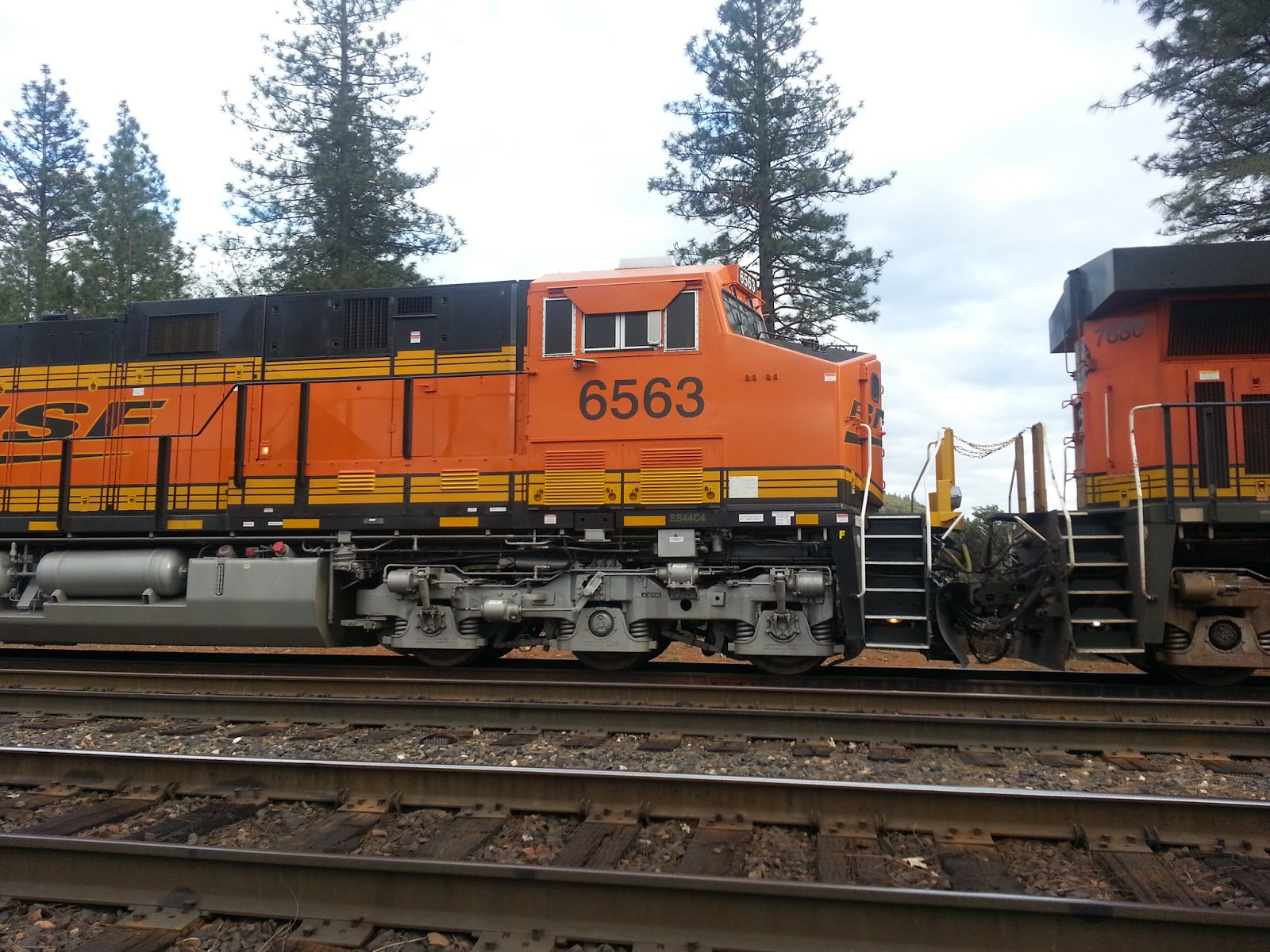
And not just any BNSF train; a BNSF train with the very newest GE power: two ES44C4s up front.

The story goes something like this:

I was coming back up to my cabin from having worked my week in Sacramento.  I customarily cruise by Colfax, Gold Run and Alta to see what, if anything, is occurring on the tracks.  I happened to catch a stalled BNSF train on the Gold Run siding, a mixed manifest.  As I got closer, I noticed the nearby block signal went green, which meant an eastbound train was approaching from the west.  I scurried back to the SUV and acquired my Flip HD camera (though actually my stupid Samsung Galaxy Note II frigging telephone takes better video), just in time to capture the below event (see it here on YouTube.  Please expand and listen with headphones for the best experience):


On point is UP 7647, a GE C45ACCTE, one of 325 such 4400-hp locomotives manufactured between 2007 and 2008 and, if you look closely in the expanded video, you can see the friendly conductor waving to me as the train approaches and passes.  In second position is UP 6214, a C44AC with 4390 hp, one of 167 such engines manufactured in 1995.  Third place heralds UP 6600, a C44AC with 4390 hp, only one of which was built for UP in 1997.

There are two DPUs mid-train, UP 5262 and UP 5277, both manufactured between 2005 and 2006, both C45ACCTEs with 4400 horsepower, of 301 such units built.

After the UP train had passed, I was waved up by the engineer, who invited me into the cab.  This was about to be a unique experience as I'd never been in the cab of any BNSF locomotive, much less a new GE ES44C4.  I knew UP locomotive cabs were absolutely filthy; I was therefore curious about BNSF cabs.

The first two BNSF units are 6508 and 6563, two of 92 such ES44C4 locomotives manufactured by GE in 2013, both with 4400 horsepower.  The third unit is BNSF 7680, an aging and fading GE ES44DC WarPumpkin with 4400 hp, one of 194 such units built in 2005.

Armed with my monster Flip HD and my phone, I placed my right foot on the bottom step, wrapped my hands around the white rails, simultaneously pushing with my foot and pulling with my hands.  I felt an immediate, white-hot and excruciating pain in my right foot and almost fell backwards off the ballast and down about a fifteen foot drop.

It took me roughly a half hour to hobble my way over the three tracks and back to my Tahoe, only about a hundred yards away on a side road.  The engineer thought I was kidding when I told him I believed I'd broken my foot trying to climb up.  Until he saw the look on my face.  I made my way, the next day, down to Auburn for a visit to a local doc-in-the-box who confirmed: yes.  Foot broken.  Hairline fracture adjacent the tuberosity of the 5th metatarsal.  Stay off foot for at least two weeks.  We don't have crutches.  You can buy them next door.  Stay off foot.  No boot.  Buy ibuprofen.

So how did BNSF 6508 move ahead?  It called for ancient power.  As you can see above in the video (again, after I'd fractured my foot, I still stayed to record this helper set), BNSF units 147 and 139 responded -- both being elder EMD GP60M B-truck units, two of 59 such 3600 hp units manufactured for Santa Fe in 1990.  It was like watching a '59 Corvette respond to a 2013 Vette.

Before I fractured my foot, however, I was able to take the below photographs with my Note II:

A photo taken just before I attempted to climb up into the cab.

(Right click on each photograph to enlarge.)

A little bit about the General Electric ES44C4:

This is a new model whose purpose is to try to make an AC unit as affordable as a DC unit, with roughly equal traction.  BNSF is, to date, the only major railroad to have purchased the C4.  ES44C4 data sheet is here.

GE indicates that, in general, the ES44 locomotives are "powered by GE’s 12-cylinder diesel engine, with the Evolution Series producing the same 4,400 HP as its 16-cylinder predecessor — using less fuel. This 45-degree, 12-cylinder, 4-stroke, turbocharged engine provides efficiency, lower emissions and extended overhaul intervals. The engine also uses enhanced cooling and higher-strength materials that dramatically improve reliability and allow for future increases in power and efficiency."

 4-cycle Model GEVO 12

GE also writes: "In North America, Burlington Northern Santa Fe Railway is using Evolution Series ES44C4 Locomotives as a cleaner, faster, safer and more reliable alternative to DC-powered locomotives. The advanced technology of Model ES44C4 reduces fuel use by 17% and emissions by 70% compared to existing DC locomotives."

The model indicates C4 because one axle -- the #2 -- is unpowered in each truck.  The ES44C4 has a variable traction control system onboard, whose software adjusts the pressure in the air cylinders and linkages on the truck side frames (see photos above) in order to vary the weight on the four actual drive axles and yield adequate traction under various grades and traction conditions -- where wheel slip may occur.  It is said that each center axle lifts for speeds below 15 mph so as to improve adhesion and get optimal tractive effort from the four AC traction motors.

GE mid-axle lifting linkage on ES44C4, close up.  Note on truck photos above.

 One quote from a railroad forum:

"My dad caught 3 of those here awhile back on a grain load, I've never heard him bitch so much about a motor. Apparently they're slippery and like all GE's, don't load worth a *. These were supposed to be a better alternative to the ES44DC's, but what I'm hearing is most would prefer a 6 axle DC over these C4's."

What people may not realize, regarding AC locomotive power in general, is this: if one traction motor goes offline, more power can be applied to the other motors.  DC traction motors can't handle the transferred load and aren't designed to do so.

This is, at least, the "argument" for producing double-truck, six-axle locomotive power with only four axles possessing traction motors. 

EMD also began production of their own version of a C4 unit, called the SD70ACe-P4.  As best I can determine, this locomotive (see photo of EMD Demonstrator #4223 by Karl Rethwisch below) likewise has two unpowered axles.  However, instead of the mid axles being unpowered, the axles closest to the fuel tank are unpowered.  Also, no axles will be physically lifted, as with the C4.


My question: did this BNSF train stall because the two locomotives on point failed to produce sufficient traction due to the design of the ES44C4s utilized?  I simply do not know.  I can't help but wonder, however.

In closing, one very interesting business point, from BizJournals.com:

GE locomotive plant plans to cut 950 jobs in Erie

GE Transportation is dealing a huge blow to the Erie economy, moving nearly 1,000 jobs to Texas with its AC locomotives and mining vehicle lines.

For GE Transportation, it apparently comes down to economics. The market for locomotives isn't as strong as it has been and the two new plants, in Fort Worth, Texas, is more productive. Plus, the Erie Times-News said the Fort Worth plant, unlike the one in Erie, is nonunion. The Erie employees earn about twice as much on average as the Fort Worth employees and the workers at a competing Caterpillar Inc. plant.

Here's the unspoken fact as well: Texas provides tax incentives and reduced regulations that Pennsylvania doesn't.  Or, on the other hand, is it simply the result of the purposeful decline of coal via onerous restrictions by the Obama Administration?

Thanks for reading, please weigh in, and be safe near the tracks.

MP154


Saturday, January 26, 2013

UP 5488 West, a pig under rainy Winter skies

[Note: before we begin, I must greatly apologize for the change in my comments section.  You may notice that I have activated Blogger's Word Verification -- a ploy I most desperately despise -- because I despise the nature of Blogger's WV itself.  This has occurred because, during the latter months of 2012, I was bombarded by -- literally -- hundreds of spam comments throughout the depth and breadth of MP154.  I operate and control four blogs and this one is, for me, the most fun to run.  Resultingly, I tried to keep it the most "pristine" and unsullied by reality, if you will.  Reality, unfortunately, has now come crashing into MP154, and I have been forced into taking measures that are anathema to me.  I hope, frankly, that you will still continue to comment should you wish. --MP154.]
_________________________________

High in the Sierra Nevada Mountains at the 4,000-foot level, less than a half mile from the original Central Pacific Railroad transcontinental tracks, I live in a two-story cabin that is now ensconced in the throes of Winter, despite all of the trials and tribulations this incurs.

There have been a few minor snowfalls, and a week of sub-zero temperatures which resulted in frozen pipes underneath the house and a nasty break.  Since then, the snow has been occasional, but the rains fairly consistent.  This video, recorded from a cell phone of all silly things, documents a Union Pacific manifest train rolling downhill towards milepost 152.  Please click on each photograph to enlarge.  These photographs are enlargements from stills of the video.


On point is UP 5488, a General Electric ES44AC, one of 141 such locomotives manufactured between 2005 and 2006 with 4,400 hp -- and labeled a C45ACCTE (the CTE for "Controlled Tractive Effort") by the Union Pacific.

Here, the video:


The YouTube link is here (3:27).  And, as with the previous post, this video was captured by a device that I'd never thought would result in anything approaching the quality delivered -- a Samsung Galaxy Note II cellular telephone.  As per normal, please click on the YouTube link for full expansion and listen with headphones.

As for the rest of the pig, the second locomotive was UP 7028, an elder GE C44 AC manufactured between 1995 and 1996 with 4,390 hp.  Third in line was UP 5271, a GE C45ACCTE with 4,400 hp and UP 5281 followed in fourth place, another such unit, one of 301 manufactured.


The DPU (Distributed Power Unit) was UP 7448, another GE C45ACCTE, manufactured in 2009, also with 4,400 hp.


Even now, as I write this in my second floor loft office (with window cracked open), I can hear another UP train approaching -- approaching the detector at milepost 154.4.

Hence the name of the blog.

Take care, be safe, guard your family and your assets in 2013.

MP154


Monday, October 1, 2012

UP 7970 West: an incredibly SHINY new locomotive consist!

There are roughly nine new videos awaiting posting on this blog, my having captured them over the past two months and then edited them down this past week.

That said, I couldn't help but push those videos all aside in order to post this video instead, which involves a quadruple set of brilliant new GE C45ACCTE Union Pacific locomotives -- also known in GE builder nomenclature as the ES44AC, in the Evolution Series.


Below, UP 7970 West takes point on a Union Pacific Z-train (UP's verbiage for a priority consist), with 8017, 7993 and 8002 behind.  [It is interesting to note that Union Pacific had, prior, given numbers 8002 and 8017 to the EMD SD90MAC (also know, in UP parlance, as the SD9043AC).]
As I customarily indicate, I recommend you not watch the video here on my site, but instead click on this link to YouTube where you can completely enlarge the image (Please click on the "HD quality" button -- makes a big difference!) and then clap on some headphones for the sound.

I first caught this wonderful consist exiting Tunnel 35 in the high granite of Donner Pass, then followed it down through Rocky Point, under Interstate 80, and the single track at MP 135.

I had a friend with me for the day, and we had previously captured UP 8441 running eastbound through Switch 9 (video coming).

As a very strange aside, when we parked and then began to hike down to the tracks, we passed a white cranker transient chick -- with no pack, no boots, equipment -- who neither spoke nor met our eyes as we walked by.  Quite bizarre.  She disappeared.  I almost expected the windows of my SUV to be broken and the rest of my camera and video equipment to be gone when I returned.  However, as my guest pointed out, she wouldn't have possessed the muscle to do so.


Above, UP 7970 rolls down towards Rocky Point in the late afternoon Sierra Nevada mountain sunshine.


Here, I caught UP 8002 passing near MP135, a close detail of its freshly-painted cab, labeling and UP side shield.

Bottom line: these UP units are so new that they are not yet listed in James Kerr's DPA-LTA book nor are they accessible on the internet.  You'll just have to trust me on their nomenclature.

I love new units, and I enjoy posting things that that bulk of Traindom doesn't quite seem to yet possess.

MP154

P.S.
Click on the photos -- captures of my videos -- in order to expand their size.  And finally: I am having to deal with the "new Blogger" and that, in itself, poses a challenge I may not be, yet, up to.

If this post doesn't quite correspond to the professional manner in which I've made prior posts, I grandly apologize.

It's now a matter of me having to re-acquaint myself with Blogger and its new iterations.  Please give me some time, if you will, to familiarize myself with this new Dashboard.